




30.09.2026: Reaching Government Schemes to the Last Person Is the Essence of Good Governance: Governor
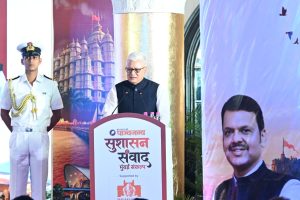
Reaching Government Schemes to the Last Person Is the Essence of Good Governance: Maharashtra Governor Jishnu Dev Varma
‘Viksit Bharat’ Is Not Merely About Higher GDP or Bank Balances; Empowering the Last Person Through the Principle of Antyodaya Is Essential
Mumbai, 30 September: ‘Viksit Bharat 2047’ is not merely a concept of economic progress, but a vision of an India that is prosperous, capable, inclusive, technologically advanced and confident in its civilisational and cultural heritage. A developed India does not mean merely a higher GDP, increased income or a larger bank balance. The effective delivery of government decisions, schemes and services to the last person in society, along with their empowerment, is the essence of good governance, said Maharashtra Governor Jishnu Dev Varma.
The Governor was speaking at the ‘Sushasan Samvad – Mumbai Sankalp’ (Dialogue on Good Governance – Mumbai Resolution), organised by the weekly Panchjanya in Mumbai.
The Governor said that Prime Minister Narendra Modi had placed before the nation the inspiring goal of Viksit Bharat 2047. The central idea of this vision is to ensure that the benefits of development reach the last person. The same philosophy is reflected in the concept of ‘Antyodaya’ propounded by Pandit Deendayal Upadhyaya. True good governance means ensuring that government schemes reach the last person in society, empower them and improve their quality of life.
Observing that ‘Sabka Saath, Sabka Vikas, Sabka Vishwas, Sabka Prayas’ is not merely a political slogan but a mantra for inclusive development, the Governor referred to the Indian philosophical ideal of ‘Sarve Bhavantu Sukhinah, Sarve Santu Niramayah’ (May all be happy; may all be free from illness). He said that taking all sections of society along and working together, with the government and society standing shoulder to shoulder, is the fundamental direction of Indian democracy.
Self-Help Groups: Examples of Social Transformation
The Governor said that the self-help group movement was not merely a government scheme or mission, but an important instrument of social transformation. Sharing his experience as Deputy Chief Minister of Tripura, where he was in charge of the Rural Development and Finance portfolios, he recalled that banks were initially hesitant to extend loans to self-help groups. However, after the government provided guarantees, lending to women’s self-help groups increased. Experience showed that the rate of loan default among these groups was less than one per cent.
He said that when women and ordinary citizens are trusted, that trust is repaid in the form of development. The financial integrity and sense of responsibility demonstrated by women constitute an important strength in the country’s development process.
The Governor observed that revolution does not necessarily mean taking to the streets and launching protests; bringing about positive transformation is also a form of revolution. He referred to the Indian tradition of dialogue, discussion, deliberation and action, adding that positive change brought about through public participation is more sustainable.
There Should Be No Wall Between Government and Society
The Governor emphasised that the first condition for good governance is the absence of any wall between the government and society. The government is not an entity separate from society; it emerges from society itself. Therefore, a division in which government offices are on one side and society on the other cannot be accepted. Both must work together to achieve common objectives.
He said that earlier, there was uncertainty about whether government projects would be completed on time. However, a mission-mode approach to work has now evolved. The government must have clear goals, a sense of urgency in achieving them and a firm commitment to delivering results. Along with ‘Ease of Doing Business’, the government must also focus on ‘Ease of Living’.
In a democracy, cooperation with a government elected by the people is more important than confrontation. The empowerment of weaker and disadvantaged sections must receive the highest priority. While the law of the jungle is based on the survival of the strongest, the principles of democracy and Antyodaya are centred on the welfare of the weakest among the weak.
Good Governance Must Reflect Indian Conditions
The Governor advised that India should learn from good practices followed abroad but avoid blindly imitating them.
Referring to the thoughts of Mahatma Gandhi, he said that the winds of ideas from across the world should enter through our windows, but they should not blow away our roof. It is essential to develop a system of good governance that takes into account Indian conditions, culture, values and the needs of the people.
He observed that a scheme or administrative practice suitable for Maharashtra may not necessarily be equally suitable for Tripura or Gujarat. Given India’s diversity, reaching government services to the last person in every region requires patience, sensitivity and an understanding of local circumstances.
India’s identity is shaped not merely by its geographical boundaries, but also by its ideas, culture and way of life. Indian values must therefore be reflected in the governance system as well. In India, unity is given greater importance than uniformity. The concept of ‘Ek Bharat, Shreshtha Bharat’ embodies unity in diversity and inclusiveness.
Politics Without Ethics Is Unacceptable
The Governor said that equality, justice and development should not be defined exclusively through the framework of Western economic or class-based ideologies. Referring to Pandit Deendayal Upadhyaya’s concept of ‘Integral Humanism’, he said that all human beings are equal, irrespective of caste, sect, religion or any other distinction. This Indian philosophy must be reflected in government policies and their implementation.
He emphasised that politics must be founded on ethics and values. Politics without ethics cannot be accepted. When the underlying vision of a government is clear, policy formulation and implementation also proceed in the right direction. However, if the basic concept itself is flawed or biased, policies and their implementation can also move in the wrong direction.
The Governor concluded that good governance means policies based on clear ideas, their effective implementation, the ability to deliver services to the last person in society and faith in the people of the country.
Congratulating Panchjanya for bringing together representatives from different fields to deliberate on good governance, the Governor observed that the printed word continues to enjoy special credibility and significance even in today’s screen-dominated era. He expressed the hope that the ‘Mumbai Sankalp’ emerging from the Panchjanya Dialogue would provide new ideas and inspiration for concrete action towards good governance and national development.
Earlier, in his introductory remarks, Panchjanya Editor Hitesh Shankar said that the initiative was not merely a discussion or a conclave, but an effort to examine social issues, questions, curiosity, misconceptions and realities through critical and constructive dialogue.
He noted that various sessions had deliberated on Maharashtra’s vision, the symbolic significance of Chhatrapati Shivaji Maharaj, challenges facing society, cinema, India’s growing economy, the stock market, entrepreneurship opportunities for women and youth, and social concerns associated with OTT platforms. He said that the objective of the initiative was to build bridges of social harmony through dialogue rather than deepen social divisions.
Managing Director of Bharat Prakashan Arun Kumar Goyal proposed the vote of thanks. He said that the affection and guidance extended by the Governor to Panchjanya and Bharat Prakashan from time to time were valuable to the organisations.
Managing Director of Bharat Prakashan Arun Kumar Goyal, Panchjanya Editor Hitesh Shankar and dignitaries from various fields were present on the occasion.